
Lincoln Parole Versus Probation
Parole is conditional release from a sentence administered by the West Virginia Division of Corrections and Rehabilitation. The independent West Virginia Parole Board decides whether to grant parole, while WVDCR Parole Services supervises the person after release. Probation is judicial supervision. It is imposed by a court instead of confinement or as part of a sentence, and the court probation structure remains the key source for its terms. An ordinary Lincoln County probationer does not become a DCR parole client merely because both forms involve reporting.
The distinction controls where to verify the record. A parole question begins with the state sentence, Board action, and DCR release record. A probation question begins with the Lincoln County magistrate or circuit case, the probation order, and the court office that carries out that order. Neither status should be inferred from a person disappearing from Western Regional Jail.
| Point | Parole | Probation |
|---|---|---|
| Legal source | Conditional release from a WVDCR sentence | Order entered by the sentencing court |
| Decision maker | West Virginia Parole Board | Magistrate or circuit court, as the case requires |
| Supervising route | WVDCR Parole Services | Judicial probation structure |
| Best proof | Board action plus DCR release and supervision records | Filed probation or revocation order |
| End point | Formal discharge from parole | Court-recorded completion or discharge |
- Parole
- Conditional community release while part of a state sentence remains under correctional control.
- Probation
- Court-ordered supervision that may replace or follow a jail term.
- Discharge
- The formal end of the supervision obligation, not just release from a facility.
- Absconder
- A person reported as having left supervision or failed to remain available as required.
Verify Lincoln Post-Release Supervision
No official public person-by-person parole or probation lookup was found for Lincoln County. Verification therefore depends on matching the person to the right record and office. A released person may have a DCR parole record, a Lincoln court probation order, neither form of supervision, or a transfer that was never a community release. Begin with the sentence source instead of assuming that any current-custody absence means supervision.
- Identify whether the case was a Lincoln County court matter, a state prison sentence, or an interstate supervision matter accepted by West Virginia.
- For a state sentence, review the WVDCR offender and release record, then check the West Virginia Parole Board material for the relevant action.
- For court probation, locate the magistrate or circuit case and request the filed probation, modification, revocation, or discharge order from the clerk.
- Contact the Huntington Parole Office to confirm Region 1 routing and ask what status information can lawfully be disclosed.
- When the sources conflict, request the focused DCR release or supervision record rather than relying on a roster or an informal statement.
The Lincoln County released inmate search and records path explains how to reconcile the physical release event with the court order. That event record is important because a Board grant or an eligibility date does not prove that Western or another DCR facility completed a release.
Note: A parole eligibility date marks possible consideration, not a hearing result, grant, or completed Lincoln County release.
Lincoln Parole Routes Through Huntington
Lincoln County parole service is based outside the county. WVDCR places Lincoln in Region 1 with Cabell, Mason, Putnam, and Wayne Counties, and the Huntington Parole Office serves that group. The office is a practical contact for routing, reporting, and questions about permitted parole information. It is not an open name index, and staff may limit what they disclose.
Huntington Parole Office
100 Price Industrial LaneHuntington, WV 25705
Phone: 304-528-5515
Coverage: Region 1, including Lincoln County
The official WVDCR Huntington office page is the source for the published Lincoln County service route.
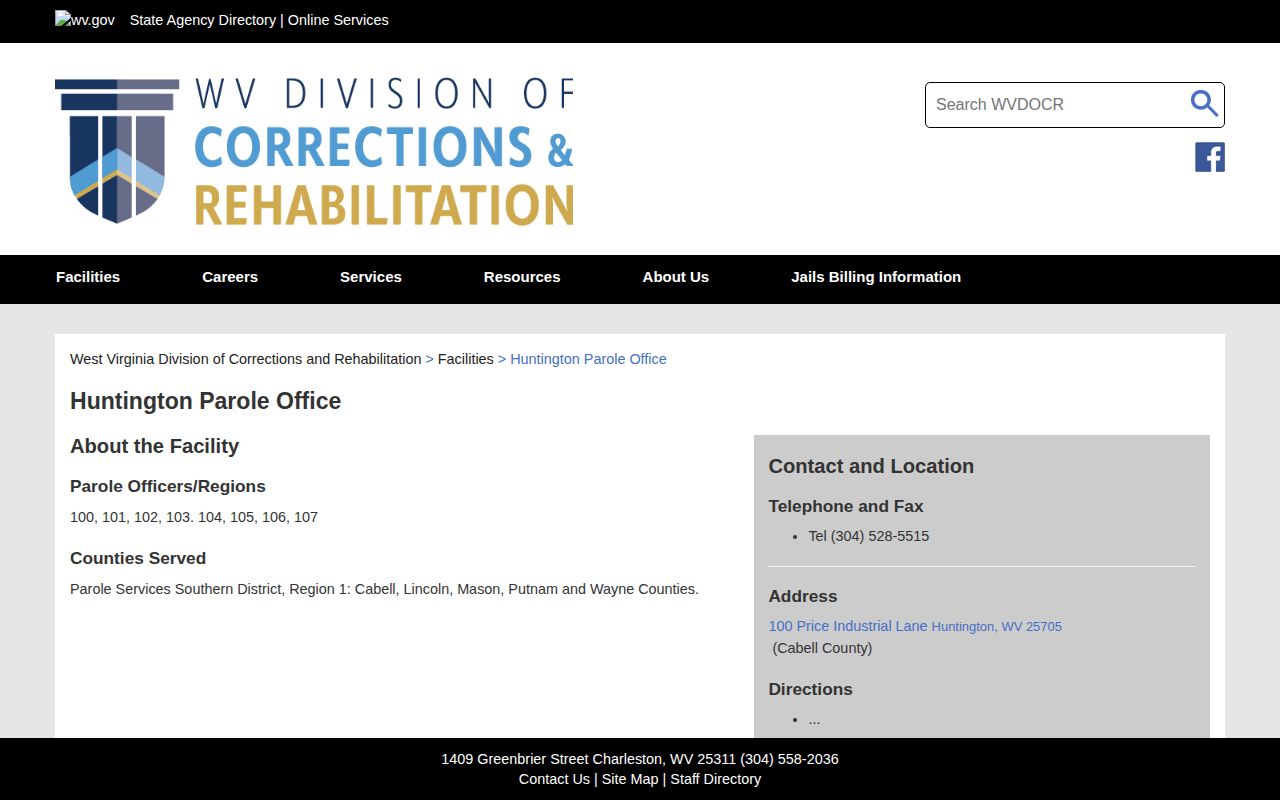
The office listing lets a reader confirm the state agency, address, phone, and county coverage before making contact. Save the source date because DCR can revise office assignments.
A useful source quirk deserves care. Two DCR pages use different district labels, calling the larger unit “Western” in one place and “Southern” in another. Both identify Region 1 and the same five-county service area. Readers should use Lincoln County and Region 1 to find the office, not try to resolve the agency's conflicting district name. Calling the published Huntington number is the safest way to confirm the current routing.
Parole Services also handles interstate parolees and probationers accepted by West Virginia. That interstate role does not move all local court probation under DCR. Ask which legal order controls before treating the Huntington office as the custodian.
Lincoln Parole Conditions and Records
WVDCR publishes standard conditions of parole. They include prompt initial reporting as directed, and the official material indicates reporting within 24 hours. The actual certificate and case record control for a named person because special parole conditions may also apply. Conditions can address reporting, approved residence, travel, conduct, treatment, and compliance with the law, but a general list cannot establish what happened in one Lincoln County case.
A claimed violation can lead to investigation, a warrant, arrest, and a revocation process. The Parole Board handles revocation after DCR reports alleged violations. A person can be released from a DCR facility, remain on parole, return to Western Regional Jail on an alleged violation, and later be released or discharged. Each stage creates a different record. VINE can report some custody changes, but the event label must be read closely. An alert for transfer, escape, or death is not a community release or a supervision discharge.
The strongest proof comes from the filed or agency record: the parole certificate, a DCR supervision record, the Board action, or a court order. Office contact helps with navigation, while those documents establish the status.
Lincoln Absconder Status Has Limits
DCR's Escapees and Absconders channel may identify a parole or custody problem. The label is narrow. Presence can show that DCR reports the person as unavailable to supervision, but it does not prove where the person is now held. It also does not establish the status of the underlying Lincoln County court case.
Absence has limits too. A name not shown on that channel is not proof that parole ended, that a warrant was cleared, or that a sentence was discharged. Name spelling, record timing, agency scope, and later action can all affect what appears. Verify a possible warrant or absconder issue through DCR and the relevant court record. For present custody, use the agency that may hold the person rather than a supervision list.
Note: A Lincoln County court order is the better source for an ordinary probation violation, revocation, or discharge.
When Lincoln Parole Ends
Physical release and parole discharge are separate milestones in West Virginia. Under West Virginia Code §62-12-18, parole ordinarily continues toward the maximum sentence after lawful deductions. DCR may seek early discharge from the Board chair after a person has served at least one year on parole. A person on life parole cannot be discharged in less than five years. Those time thresholds describe when action may be available, not an automatic end date.
Use precise terms when checking Lincoln County supervision. “Released” can mean the person left the facility subject to parole. “On parole” means correctional control continues in the community. “Discharged from parole” means the parole obligation formally ended. A past release date proves only the first event unless the record also shows discharge.
For probation, the sentencing court's order controls. Completion, modification, revocation, and discharge should be confirmed in that court record. A DCR parole office cannot replace a Lincoln judicial order, just as a court docket does not supply the exact time DCR completed a physical release. Reconcile the sources when both custody and supervision dates matter.
Lincoln Parole Board Evidence
The Parole Board's monthly calendar is a scheduling tool, not a decision search. No public name-searchable outcome database was found. A calendar entry can show that consideration was planned, while a grant may still depend on an approved home plan or other conditions. Denial, further consideration, postponement, and rescission are also possible actions. None of those terms should be converted into a release date without DCR proof.
Eligibility is sentence-specific. West Virginia Code §62-12-13 generally links consideration to the minimum term of an indeterminate sentence or one fourth of a definite term, but offense rules and prerequisites can change the analysis. The offense date and sentencing order matter. The Board's action explains the conditional decision; the DCR release event shows whether and when the facility carried it out.
The record chain is clear: sentence and eligibility, Board action, DCR release, active supervision, then discharge. Keeping those records separate prevents a common Lincoln County error, treating the first possible parole date as proof that a person left custody or finished supervision.
When documentary proof is needed, ask for the smallest record that answers the issue. A Board action can address the decision, a DCR event record can address physical release, and the supervision or discharge record can address ongoing control. For court probation, request the filed Lincoln order instead. This record-by-record method avoids asking one office to certify an event controlled by another.
Public Record Search
Sponsored Results